Spare Parts Store
 Where to Buy
 My Pick List
 Service & Support

The Question That Saves Thousands
The $10,000 Mistake I Almost Let a Customer Make
Last week, I had a consultation call that perfectly illustrates why we ask questions before quoting products.
The caller started like many do: “We need an emergency communication system. We have multiple buildings, a pool, elevators, about a hundred employees, parking structures…”
They were ready to spend serious money. They’d researched IP systems, cloud platforms, and were throwing around terms like “unified communications” and “enterprise-wide integration.”
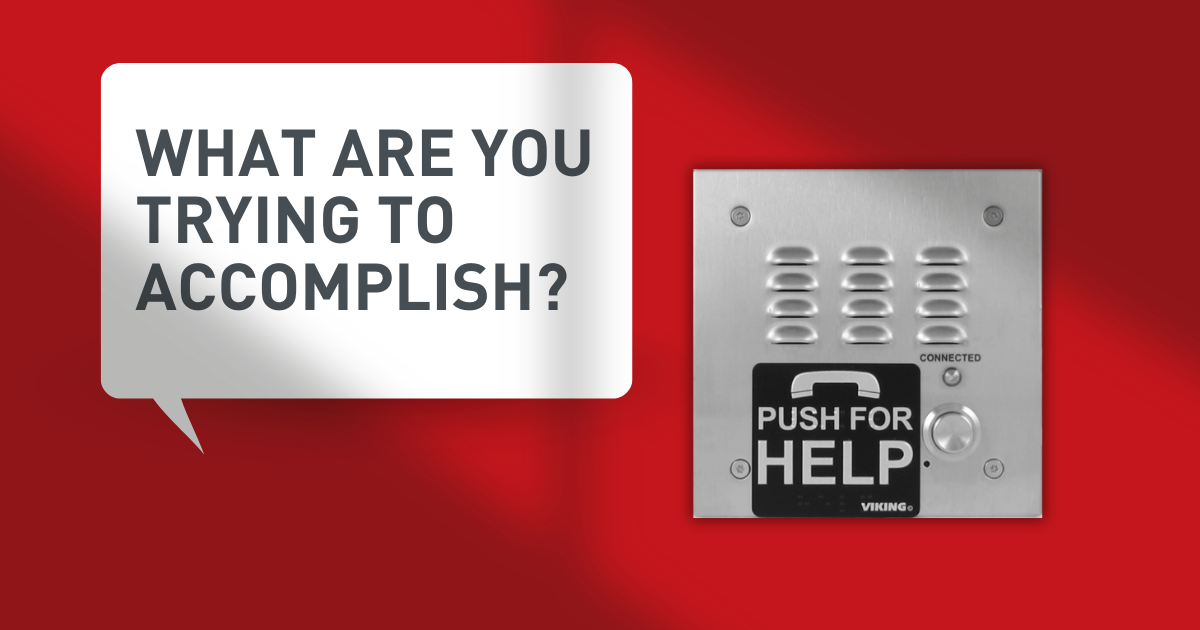
I asked my standard question: “What are you trying to accomplish?”
“Well, we want someone at our entry door to push a button and call our front desk.”
That’s it. That was the entire need.
What they thought they needed: A $10,000+ IP-based system with network infrastructure What they actually needed: A simple analog door phone that costs under $500 installed
This happens more often than you’d think.
Why Customers Overcomplicate Their Needs
They Start with Google Instead of Goals
Here’s how a typical call goes when someone’s been researching online:
“Does the PA-IP have a 600-ohm output?”
“Yes, it does.”
“Does it have an onboard amplifier?”
“Yes.”
“Can it trigger a relay?”
“Yes, but what are you trying to accomplish?”
“I want to make announcements in my warehouse.”
“Then you don’t need any of those features. You need our PA-2A paging adapter.”
The internet is great for research, but it can send you down expensive rabbit holes.
They Don’t Know the Code Requirements
A property manager recently called about their community pool. They’d found one of our handset models online and were ready to order.
“Is this for public use?” I asked. “Yes, for our residents.”
“Then you need an ADA-compliant, hands-free model. Handsets don’t meet code for public pools.”
They had no idea. Neither did their pool contractor. This conversation saved them from a failed inspection and a reinstall.
My Consultation Framework After 30 Years
Start Here: “What Problem Are You Solving?”
Instead of feature lists, I need to know:
- Who needs to call whom?
- What triggers the call?
- Where does the call need to go?
- What happens after the call connects?
Nine times out of ten, the answer is beautifully simple: “Visitors need to reach our receptionist” or “If there’s an emergency, people need to call for help.”
Next: “Describe Your Physical Location”
- Existing infrastructure? “We have old phone lines from the previous system”
- Power availability? “There’s no electricity at that location”
- Environmental challenges? “It’s outdoors in Minnesota”
- Distance from the main building? “About 500 feet to the guard shack”
These answers immediately eliminate 80% of our product line and point to the right solution.
Finally: “Who’s Installing This?”
This is where I gauge technical ability:
“My maintenance guy will install it.” “Great! Does he have experience with phone systems?” “He installed our cameras last year.” “Does he have a butt set? A multimeter?” “A what?”
If they don’t know what a butt set is, I strongly recommend they hire a professional installer. Not because we want to upsell services – we don’t even do installations – but because I want their project to succeed.
Real Examples from Our Files
The National Restaurant Chain Panic Button
What they first asked for: A complex integrated security system with multiple zones, central monitoring, and cloud management.
After asking the right questions: They needed panic buttons in locations where staff felt vulnerable – parking lots and closing areas.
The solution evolution:
- Started with one test location using our PB-3 panic button
- Added kitchen locations after staff requested them
- Integrated with existing PA systems using our Viking paging adapters
- Now rolling out to 2,000+ locations
Key lesson: We started simple, proved the concept, then scaled based on actual usage – not imagined needs.
The Jewelry Store Security Puzzle
A security integrator called with this request: “I need something that opens a door, then 15 seconds later, activates another relay, but only after the first door closes.”
A few minutes of confusing back-and-forth later:
“Is this for a jewelry store?”
“How did you know?
“It’s a man trap. Two doors, one person at a time.”
“Oh! Yes, exactly!”
Once we knew the application, we could recommend our C-500E-40-EWP with programmable relay timing. Simple. But without knowing it was a man trap scenario, we were trying to solve a puzzle blindfolded.
When You Actually Need the Complex System
Sometimes the expensive solution is the right solution. You’ll know because:
- Multiple locations need central management – You’re managing 50 buildings from one location
- Integration is mandatory – Your security platform requires specific protocols
- Remote access is critical – You need to program and monitor from off-site
- Compliance requires it – Some healthcare facilities need specific features
But here’s what I’ve learned: If you truly need these features, you already know it. You’re not asking “What do I need?” You’re asking “Does your system support SNMP?” or “Can you provide a SIP endpoint?”
The Expensive Technology Trap
I’ll get two calls in the same day:
Morning caller: “I’m done with analog! It’s ancient! Everything must be IP, POE, cloud-connected!”
Afternoon caller: “IP is unreliable garbage! The network goes down and we can’t even call for help! Give me bulletproof analog!”
They’re both right. And both are wrong.
The truth? Each technology has its place:
Analog Makes Sense When:
- Your budget is under $1,000
- You have existing phone lines (why pay to run new cable?)
- Power reliability is critical (line-powered phones work during outages)
- You want zero monthly fees
- Simplicity matters more than features
IP Makes Sense When:
- You need remote management
- Everything else is already networked
- Your IT department has banned analog
- You need detailed usage reports
- Integration with other systems is required
The Consultation That Shocked a Customer
A homeowner called about our X-Series video entry system for their residence.
“Do you have Cat6 cable run to your door?”
“No.”
“Do you have a door strike or mag lock?”
“No.”
“Do you have a static IP for remote access?”
“I don’t know what that is.”
“Honestly? Just get a Ring doorbell. It’s perfect for residential use.”
They were shocked. “You’re talking me OUT of buying your product?”
Yes. Because in six months when they couldn’t get it working, they’d blame Viking Electronics. I’d rather be honest than make a sale that results in a frustrated customer.
How to Get the Right System (Not the Expensive One)
- Write down your actual needs in one sentence. If it takes a paragraph, you’re overthinking it.
- List what you already have. Phone lines? Network drops? Power outlets? Work with existing infrastructure when possible.
- Be realistic about installation. If you’re not comfortable with technical work, budget for professional installation.
- Start simple, expand if needed. You can always add features. You can’t un-spend money on complexity you don’t use.
- Talk to someone who’s done this before. A 10-minute consultation can save thousands of dollars.
Your Next Step
Before you Google another emergency phone model or request another quote, ask yourself:
“What am I trying to accomplish?”
If you can’t answer that in one sentence, you need a consultation, not a catalog.
That’s why we still answer the phone here at Viking Electronics. After 30 years of these conversations, I can usually save you 90% on what you thought you’d spend – and get you a better solution.
Because ultimately, it’s not about selling products. It’s about solving problems.
And most problems are simpler than you think.
Written by Allison Trapani based on thousands of real customer consultations. Names and specific details have been changed to protect customer privacy.
Have a question about your emergency communication needs? Contact our sales team for a consultation.

Allison has been part of the Viking family since 1995, bringing creativity and energy to everything she does. From designing bold ads to keeping our website looking sharp and pulling together our product catalog each year, Allison helps Viking stay connected with customers in style.
Today, Allison is known for her sharp eye for design, love of language (she proudly serves as the “grammar police”), and knack for making marketing materials look great and read well.
Outside of work, Allison enjoys time with her family, working on creative projects, and experimenting in the kitchen – sometimes with mixed reviews from her family!
Favorite quote?
“I love deadlines. I like the whooshing sound they make as they fly by.” – Douglas Adams